Barcode history
The history of the QR Code
The QR Code began as a factory problem: how to read more information, faster, in less space. Three decades later it is one of the most recognizable visual interfaces between the physical world and the web.
Origin
A better code for the production site
DENSO WAVE traces the QR Code back to requests from manufacturing sites. In the 1990s, automotive production was moving away from simple mass production toward more detailed control of many product variations. Linear barcodes could not carry enough information, so workers often had to scan several codes for a single process.
Masahiro Hara, then working on barcode scanners and optical recognition at DENSO, led the development of a new two-dimensional code. The goal was not simply to store more data. The code also had to be compact, fast to read and reliable in real production environments.
Early 1990s
Production lines needed more than one-dimensional barcodes could offer
DENSO's manufacturing sites needed faster reading and more data capacity as automotive production became more detailed and flexible.
1994
DENSO WAVE introduced the QR Code
Masahiro Hara and a small development team created a two-dimensional code designed for high-speed reading, compact printing and larger data capacity.
1997-2000
Standardization moved the code beyond one company
The QR Code was standardized by groups including AIM International, Japanese standards bodies and ISO/IEC 18004.
2002
Mobile phones helped QR Codes reach consumers
DENSO WAVE notes that phones with QR scanning support went on sale in 2002, helping the format move from factories toward everyday use.
2020
The QR Code received an IEEE Milestone
IEEE recognized the QR Code for its contribution to manufacturing, management and global information sharing.
Design breakthrough
Why the three corner squares matter
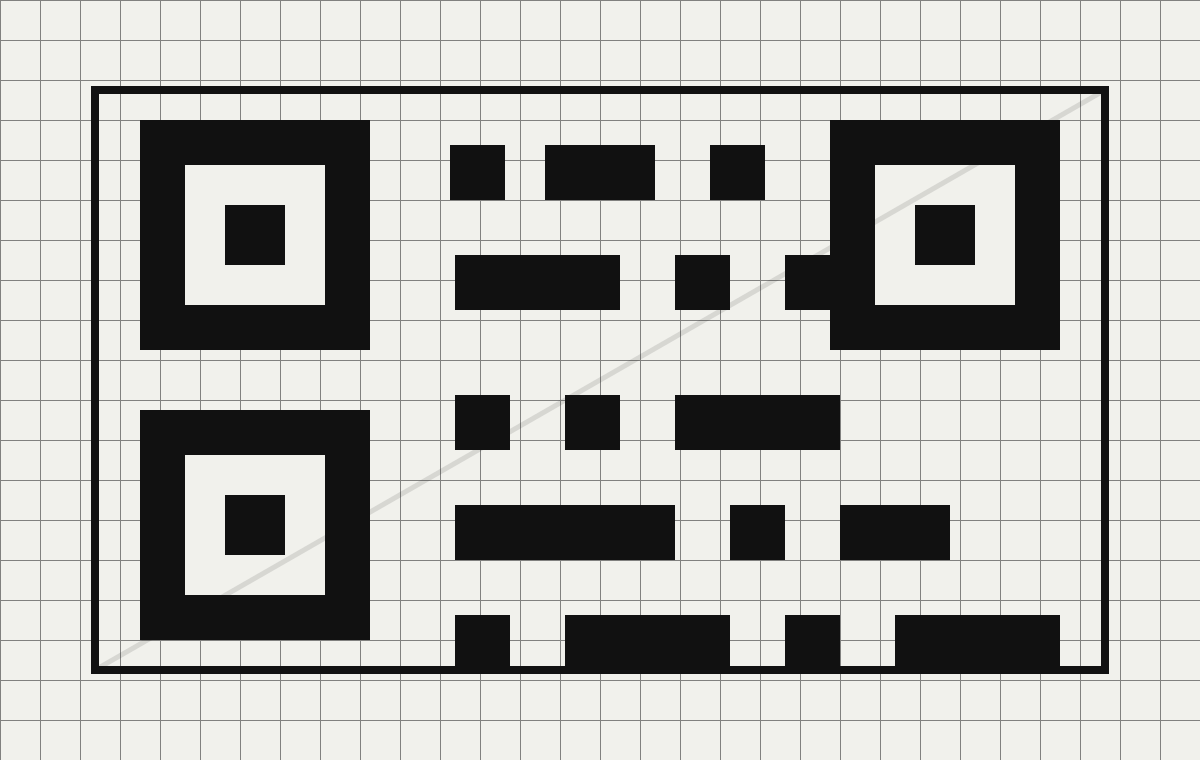
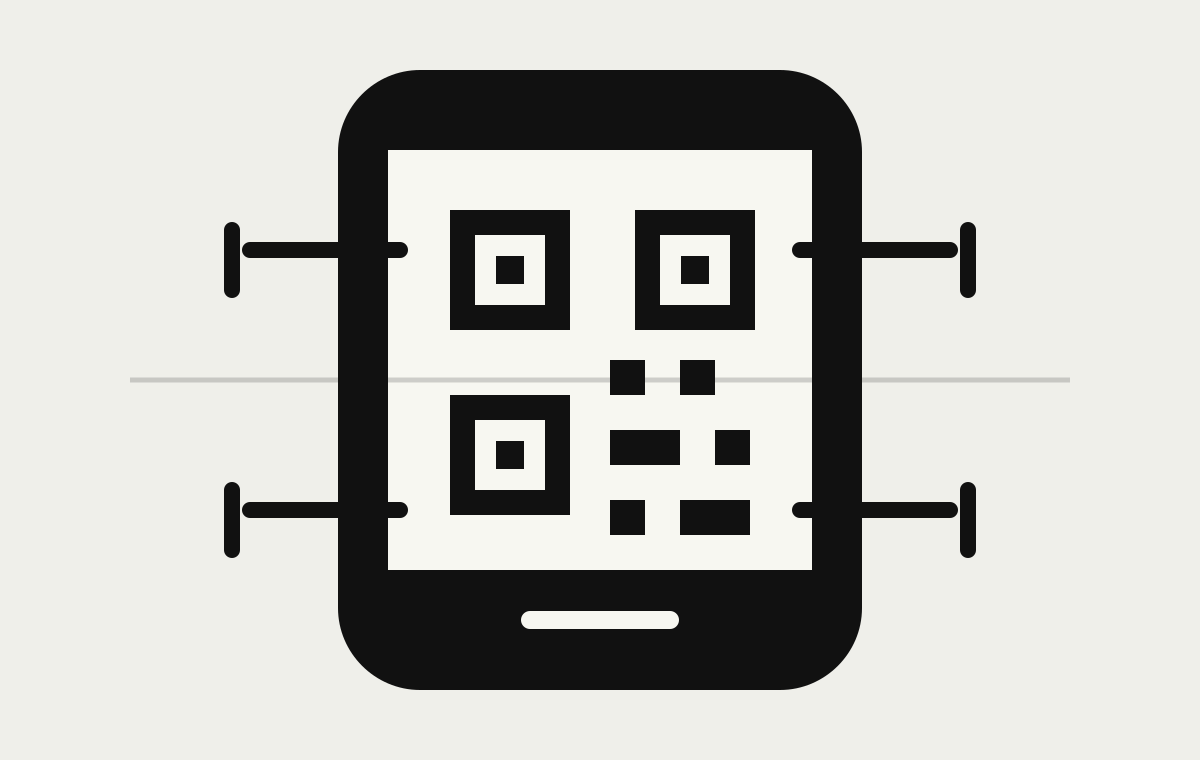
A scanner must first find the code before it can decode it. DENSO WAVE describes the position detection pattern at three corners as a key part of making QR Codes fast and readable from different angles. The team studied printed materials and settled on a black-white ratio of 1:1:3:1:1 because it was unlikely to be confused with ordinary printed patterns.
That visual signature is why a QR Code announces itself so clearly. Even at a glance, the three large squares tell both humans and scanners where the code is and how it is oriented.
Built for capacity
DENSO WAVE describes the original QR Code as capable of storing around 7,000 numeric characters and supporting Japanese Kanji characters.
Designed for damage
The format includes error correction, which helps a QR Code remain readable even when part of the symbol is dirty or damaged.
Made to spread
DENSO WAVE's 30th anniversary material describes QR Code as standardized for free use in 1994, helping adoption beyond its original manufacturing context.
Standardization
From factory tool to international standard
The QR Code became more than a proprietary factory tool through standardization. DENSO WAVE lists milestones including AIM International in 1997, Japanese standards work in 1998 and 1999, and ISO/IEC 18004 in 2000. ISO now publishes the current QR Code symbology specification as ISO/IEC 18004:2024.
That standards path matters because QR Codes are expected to be read by many different scanners, apps and systems. The familiar square pattern only became globally useful because the rules for making and reading it could be shared.
What changed later
QR Codes moved from production lines into tickets, advertisements, product packaging, payments and everyday phone interactions. DENSO WAVE notes that mobile phones with QR scanning support appeared in 2002, which helped the format leave the factory floor and become familiar to the public.
Why it still works
A QR Code is visually simple, compact and fast to scan. It can bridge a printed object to a digital action with almost no explanation. That is why a code invented for automotive parts management can now appear on restaurant tables, posters, shipping labels, museum signs and product packaging.
Sources
This page uses conservative, source-backed facts. If a claim could not be verified from a reliable source, it was left out.